 Bright Shelf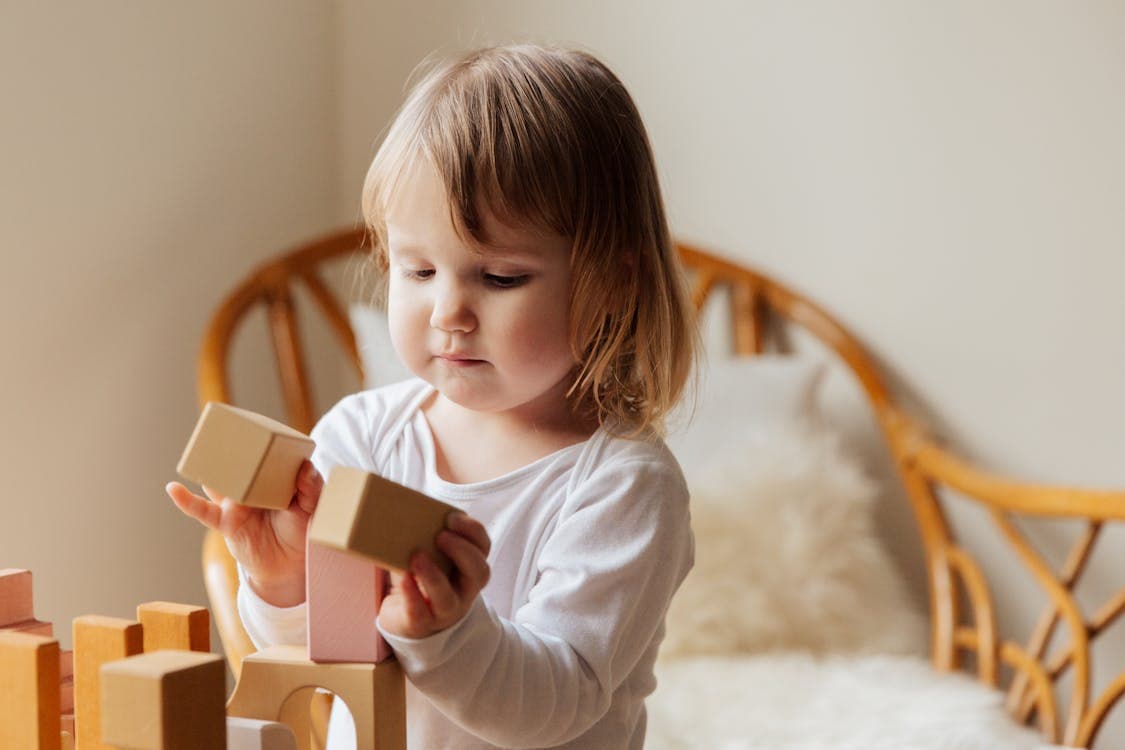
Toy design has two possible goals: hold the child's attention or develop the child's capacity. These are not the same thing and frequently work against each other. A toy built to hold attention needs novelty, rewards, and escalating stimulation. A toy built for development needs to be hard enough to be interesting and open-ended enough to work differently as the child grows. The first type sells well. The second type gets played with for years.
The clearest signal is what happens in week two. The novelty week is not diagnostic. Almost anything holds a child's attention when it is new. Come back after the initial excitement has faded and watch what the child does. Do they find new ways to use it, or has the toy run out of possibilities? A reward-loop toy peaks fast and stays flat. A good toy gets more interesting as the child gets more capable.
The design mismatch matters because the person buying the toy and the person using it are different people with different needs. A parent evaluating a toy at point of purchase is responding to packaging copy, price signals, and the word educational. The child using the toy for the 40th time is responding to whether it still has something to offer. Toy companies optimized for the parent's buying decision long before they worried about the child's sustained play experience. The result is a generation of products very good at getting into a cart and much worse at staying relevant past the first week.
LOL Surprise dolls are the clearest case. The entire product is the unboxing: layered packaging engineered to create a dopamine sequence that ends at the doll. The doll itself has no meaningful play value. After 30 minutes the child wants the next one, which is by design. Contrast that with Play-Doh, which a 2-year-old uses for sensory exploration, a 4-year-old uses to make elaborate food, and a 6-year-old uses to sculpt characters. Same material. Completely different experience at every age. No batteries required.
Electronic learning toys for young children are the most persistent version of the same problem. VTech and LeapFrog build products that use the word educational on every surface and operate through reward loops: press the correct button, hear the sound, earn the praise. The Hirsh-Pasek criteria for meaningful learning are active, engaged, meaningful, and socially interactive. A child pressing a button to hear a pre-recorded alphabet is none of those things. It is a child learning to press buttons. A set of plain alphabet blocks that a 2-year-old stacks, a 3-year-old sorts, and a 4-year-old uses to spell their own name has no batteries, usually costs less, and has a developmental through-line that runs for years.
Before buying, three questions are worth asking. First: does this toy have a correct outcome? If yes, it is probably rewarding compliance rather than building capacity. Second: what does my child do with this on day 10, not day 1? If you cannot picture it, the toy probably cannot either. Third: could a younger or older sibling use this too, or does it serve exactly one age and expire? The toys that survive are almost always age-agnostic. That flexibility is the signal.
The growth curve question is the most useful single filter. A good toy gets harder as the child gets more capable, not through new modes added by the manufacturer but through what the child brings to it. A 3-year-old with Magna-Tiles makes flat shapes. A 4-year-old makes towers. A 5-year-old makes towers with rooms and doors. The toy did not change. The child's capacity for spatial reasoning did, and the toy had room for that growth. When a toy's ceiling is fixed by its own design rather than by the child's developing capability, it will stop being interesting at a predictable point and nothing you do will change that.
The honest version of this: the toys that cost the least and look the least impressive in the store are usually the ones that last longest. Plain wooden blocks. Play-Doh. A cardboard box. No batteries to replace, no sounds to mute, no fixed play path. They are not clever. They are good. That distinction is worth keeping in mind every time you open a toy website.
Our Pick
Play-Doh Classic 4-Pack · Top Pick · 18 months–6 years
Open-ended, no reward loops, and a completely different experience at 2 versus 4 versus 6. The fine motor work is constant and the child never notices they are doing it.
See full review →